






Global earnings growth has surged this year. Companies in the S&P 500 are now expected to grow earnings by 28 per cent in 2026, nearly three times their long-term rate of 10 per cent. [1] With the index trading at around 20 times forward earnings, some may argue that such extraordinary growth helps justify an otherwise elevated valuation.
However, there are several unusual features behind this year’s earnings boom. A large part is being driven by enormous levels of AI capital spending that may not continue indefinitely. The earnings benefits of that spending are also arriving much faster than the associated costs. And some reported earnings have been boosted by rising valuations of private AI investments. [2]
We will leave the increasingly complex web of AI financing, which has been well covered elsewhere, to others. Instead, we want to focus on the second of these effects: a simple accounting lag that could have important consequences for S&P 500 earnings over the next few years.
Taken together, these factors mean that the earnings growth underpinning current valuations is considerably less impressive than it may first appear, and a great deal more uncertain.
When capex becomes an expense
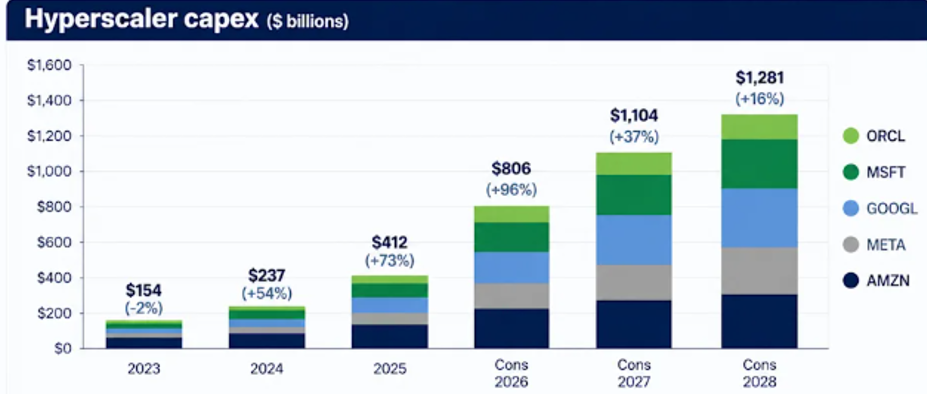
The scale of the AI build-out has few historical precedents. The five largest hyperscalers are expected to invest around $800 billion on capital expenditure (capex) this year, up 96 per cent on 2025, rising to $1.1 trillion in 2027 and $1.2 trillion 2028 (see Figure 1).
Figure 1: Annual Capital Spending of the Largest US Hyperscalers
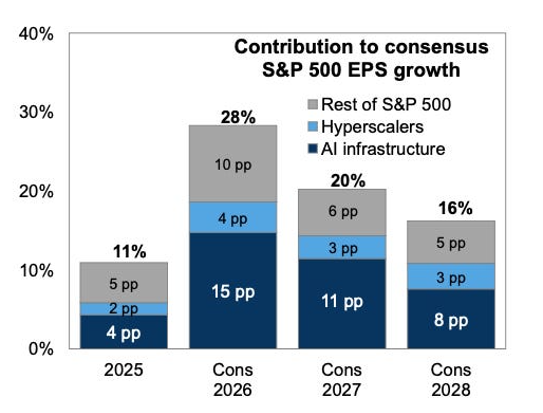
For the companies supplying that infrastructure, the spending is already turning into earnings. Semiconductor manufacturers, technology hardware companies, industrial businesses and utilities have been the main beneficiaries, collectively accounting for roughly half of the growth in consensus S&P 500 earnings this year (see Figure 2).
Figure 2: Contribution to Consensus S&P 500 EPS Growth by Hyperscalers, AI Infrastructure Companies and the Rest of S&P 500
For the hyperscalers making these investments, the impact on earnings is very different. While the spending is already showing up in greatly reduced free cash flow, much of it has yet to appear as an expense on their income statements. This reflects a simple accounting principle. The hyperscalers pay for the chips and equipment upfront, but rather than charging the full cost against profits immediately, they record them as assets and spread the cost over their expected useful lives through depreciation.
The result is a timing mismatch: the seller recognises most of the earnings benefit immediately, while the buyer’s cost only begins to flow through the income statement gradually, once the assets are installed and in use. At steady levels of capital spending, this timing difference is largely inconsequential. At today’s scale, it becomes far more significant.
This year, the hyperscalers are expected to spend around $800 billion on capital expenditure, while recording roughly $201 billion in depreciation and amortisation.[4] The two figures are not directly comparable: this year’s depreciation relates largely to assets purchased in previous years, while much of today’s capex will be depreciated in the years ahead. But the gap illustrates the scale of the lag. Hundreds of billions of dollars being invested today will only be recognised as an expense over the years to come. With investment still rising rapidly, the depreciation charge associated with the assets already being built will continue to grow for years even as capex growth eventually slows.
Where to from here?
From here, the earnings path becomes much less certain. Even if hyperscaler capital spending continues to rise in absolute terms, as consensus currently assumes, it is expected to do so at a progressively slower rate (see Figure 1). The infrastructure and equipment suppliers will still benefit from higher spending, but the year-on-year boost to their revenues and earnings becomes smaller. At the same time, the depreciation expense recognised by the hyperscalers continues to rise as the enormous amount invested over the past several years works its way through their income statements.
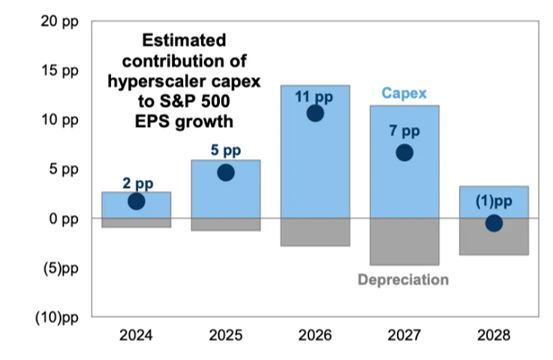
Goldman Sachs estimates that this shift becomes increasingly important from 2027. It expects AI-related capital spending to add around 11 percentage points to S&P 500 earnings growth that year, while rising hyperscaler depreciation offsets nearly half of that benefit, reducing the net contribution to around 7 percentage points. By 2028, Goldman expects the depreciation drag to offset the earnings uplift from continued capital spending entirely, leaving the net contribution from the AI investment cycle slightly negative (see Figure 3).
Even on consensus assumptions, then, the earnings tailwind from the capex boom fades as depreciation catches up. Whether the current elevated rate of earnings growth can be sustained will increasingly depend on the revenues and profits those investments generate.
Figure 3: Growing Hyperscaler Depreciation Expense Should Increasingly Offset AI Capex Beneficiary Earnings
This is where the outlook becomes much harder to predict. Whereas depreciation can be forecast relatively mechanically from past capex and useful life assumptions, forecasting the revenues needed to offset that rising cost requires a healthy dose of ambition. The range of possible outcomes is enormous and depends heavily on your point of reference. Anthropic, for example, has reportedly discussed a potential addressable market of more than $30 trillion,[5] while its annualised revenue run-rate is expected to be $100 billion by the end of this year.[6] Bridging even a fraction of that gap would imply extraordinary growth, but both the scale and timing of that opportunity remain highly uncertain.
At the more optimistic end of that range, AI revenues would grow quickly enough to outpace the rising depreciation charge. After all, the hyperscalers are not investing simply to build data centres; they expect those assets to generate revenues from cloud workloads, AI services, advertising, productivity software and new products that may not yet exist. If those revenues develop sufficiently quickly, the larger revenue and profit base could absorb the rising depreciation charge, allowing margins and earnings to remain strong. In that outcome, today’s enormous capital commitments may prove entirely rational and current earnings forecasts could ultimately prove conservative.
At the other end of the range, AI revenues may develop too slowly to justify the scale of investment. If the hyperscalers continue investing at current levels, rising depreciation without a commensurate increase in revenues and profits would put pressure on their margins and earnings. Alternatively, they may respond by cutting spending aggressively. That would improve their own free cash flow and eventually slow the accumulation of depreciation, but the effect would be felt elsewhere first. With AI infrastructure spending accounting for roughly half of consensus S&P 500 earnings growth this year, weaker capex would remove one of the index’s largest current sources of earnings growth almost immediately. In either case, disappointing AI revenues would bring today’s elevated rate of S&P 500 earnings growth sharply back down to earth.
The useful lives of the assets themselves add another layer of uncertainty. GPUs are typically depreciated over several years, but rapid advances in AI models and hardware make their economic lives difficult to judge. New generations of models may require newer and more powerful chips, shortening the economic life of today’s GPUs; alternatively, older equipment may remain productive for inference and less demanding workloads. The difference has important consequences. Shorter useful lives would mean faster depreciation and greater replacement capex, while longer lives would reduce both. The pace of technological change therefore has important implications for the future cost of the AI build-out and the returns hyperscalers ultimately earn on today’s investment.
A wider range of outcomes
None of this means that today’s investment will fail to earn an attractive return. Our base case is that the current rate of capital spending cannot be sustained indefinitely. At the same time, the investments being made today may ultimately generate substantial revenues and profits. Indeed, these are questions we are considering closely through our investments in Alphabet and Microsoft, two of the hyperscalers at the centre of this capex build-out.
But the implications extend well beyond the hyperscalers themselves. The exceptional earnings growth of the S&P 500 today reflects a combination of rapidly rising capital spending and a lag before much of its associated cost reaches the income statement. We know that depreciation will catch up and that capex growth cannot accelerate at its current rate indefinitely. What we cannot know with the same confidence is how much revenue all this investment will ultimately generate. That makes the headline rate of earnings growth a particularly uncertain foundation on which to assess today’s valuation. It may prove sustainable if AI revenues develop sufficiently quickly. But it could also fall sharply as depreciation rises, capital spending slows or the expected revenues fail to materialise.
This is very different from the earnings growth we seek in our own investments. Our focus is on companies where structural demand, competitive advantages and high returns on capital give us confidence that earnings can grow sustainably and predictably over many years. The S&P 500 may look reasonably valued at 20 times forward earnings when accompanied by 28 per cent earnings growth, but the earnings supporting that valuation have also become considerably less predictable.
[1] 2026 earnings growth estimate from Goldman Sachs Global Investment Research, excluding “other income”. S&P 500 earnings compounded at 9.8 per cent a year over the 16 years to 31 December 2025: Factset, Seilern Investment Management.
[2] The 2026 S&P 500 earnings growth estimate excludes mark-to-market gains on Amazon and Alphabet’s investments in private AI companies. Including these gains would, on our estimates, add approximately 5 percentage points to 2026 earnings growth.
[3] Cited in https://www.benzinga.com/Opinion/26/09/62032839/is-the-massive-and-growing-investment-in-ai-infrastructure-worth-it.
[4] Depreciation estimates have been calendarised to 2026 to account for differing fiscal year-ends. Estimates for Alphabet and Amazon include depreciation and amortisation; Meta, Microsoft and Oracle estimates include depreciation only. Source: Bloomberg consensus estimates; Seilern Investment Management.
[5] https://www.wsj.com/tech/ai/anthropic-expected-to-tell-investors-it-sees-over-30-trillion-in-potential-revenue-a611efea?utm_source=chatgpt.com.
[6] https://www.ft.com/content/840ac156-af1c-4a82-b260-ae791072fcfa?syn-25a6b1a6=1.
This is a marketing communication / financial promotion that is intended for information purposes only. Any forecasts, opinions, goals, strategies, outlooks and or estimates and expectations or other non-historical commentary contained herein or expressed in this document are based on current forecasts, opinions and or estimates and expectations only, and are considered “forward looking statements”. Forward-looking statements are subject to risks and uncertainties that may cause actual future results to be different from expectations.
Nothing contained herein is a recommendation or an offer or solicitation for the purchase or sale of any financial instrument. The material is not intended to provide, and should not be relied on for, accounting, legal or tax advice, or investment advice. The content and any data services and information available from public sources used in the creation of this communication are believed to be reliable but no assurances or warranties are given. No responsibility or liability shall be accepted for amending, correcting, or updating any information contained herein.
Please be aware that past performance should not be seen as an indication of future performance. The value of any investments and or financial instruments included in this website and the income derived from them may fluctuate and investors may not receive back the amount originally invested. In addition, currency movements may also cause the value of investments to rise or fall.
This content is not intended for use by U.S. Persons. It may be used by branches or agencies of banks or insurance companies organised and/or regulated under U.S. federal or state law, acting on behalf of or distributing to non-U.S. Persons. This material must not be further distributed to clients of such branches or agencies or to the general public.
Get the latest insights & events direct to your inbox
"*" indicates required fields