






An investment philosophy is a belief about where long-term returns come from, and a set of principles for acting on that belief. In our case, it guides what we research, what we choose to own and, just as importantly, what we exclude. It also allows clients to understand what they own, why they own it and what would cause us to change our minds.
Three difficult years for Quality Growth have put investors’ conviction to the test. Momentum has dominated, market leadership has narrowed and companies tied to the artificial-intelligence capital-expenditure cycle have pulled sharply ahead. Passive flows have reinforced the trend, as rising prices lift index weights and draw in further capital regardless of valuation. For any manager who has not followed that trend, the pressure to conform has rarely been stronger.
But a philosophy that is revised whenever another approach performs better risks becoming little more than a description of what has recently worked.
This newsletter looks at how we respond to changing share prices, what has changed in our companies and their valuations, and why the funds are now more differentiated from the index than they have been for many years. Together, these help to explain why we remain committed to our philosophy.
The evidence on which we act
At Seilern, we sell a company for one of two reasons: because it no longer satisfies one of our Ten Golden Rules, such as when its competitive advantage weakens, its financial quality deteriorates or management misallocates capital; or because the price no longer offers an acceptable prospective return. We buy when a business meets our Golden Rules and the balance of risk and reward is in our favour.
That is why the portfolios evolve even as turnover remains low. In the first half of this year, we added RELX and Copart to Seilern World Growth and exited Novo Nordisk. These decisions reflected our assessment of business quality, growth, risk and valuation; not whether the shares had recently risen or fallen.
A share price is information, and we treat it as such. A sharp fall may reveal a risk we have underestimated and always prompts renewed investigation. But the price movement is not itself proof that the business has deteriorated. Likewise, a rising share price does not make a company less cyclical, its earnings more predictable or its competitive advantage more durable. Our task is to distinguish between a change in the business and a change in how the market values it.
What has changed, and what has not
During the first half of 2026, the share prices of our companies moved a great deal. The evidence on the businesses themselves changed far less. Earnings growth remains healthy across all three funds. Between 2009 and 2025, underlying earnings compounded at 11.1 per cent a year in World Growth, 12.5 per cent in America and 7.8 per cent in Europa,1 despite a pandemic and the sharpest rise in interest rates in four decades. Expectations for 2026 and 2027 remain broadly in line with or ahead of those long-term trends. During the first half, earnings forecasts for World Growth and America were revised upwards even as both funds fell sharply. The companies continue to earn higher margins and returns on capital than the market, convert profit into cash and carry conservative balance sheets. By the measures that matter to our philosophy, very little has deteriorated.
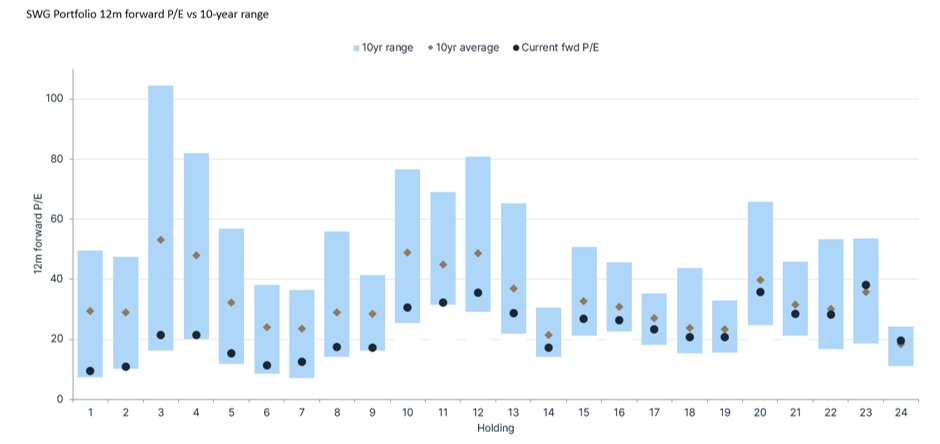
Valuations, meanwhile, have fallen sharply. All three funds now trade at around 23x forward earnings, well below their long-run averages. The de-rating is unusually broad. In World Growth, 22 of the 24 holdings trade below their 10-year average multiple and 16 sit in the cheapest fifth of their own 10-year range, across software, healthcare and financials alike. Prices have fallen across almost the whole portfolio while earnings have not.
Figure 1: Distribution of Seilern World Growth holdings across their own 10-year forward P/E range
Quality stocks are near all time low valuations
Why the index is not necessarily the safer option
Forecasts for the S&P 500 were revised upwards far more sharply over the same period, driven largely by the AI capital-expenditure cycle. For many investors, that stronger outlook and the diversification an index appears to offer are reason enough to move towards it. But an index can hold a large number of securities and still be concentrated in its underlying growth drivers.
Owning more securities does not necessarily mean owning more independent sources of return. The 10 largest companies in the S&P 500 account for over 41 per cent of the index,2 and many are direct beneficiaries of the AI capital-expenditure cycle. Exposure to that spending extends well beyond them, through utilities exposed to data-centre demand, industrials benefiting from construction orders and banks earning fees from the boom. We have always judged diversification by underlying growth drivers rather than sector labels. By that measure, the index is more concentrated than its sector mix suggests.
For an investor moving from a differentiated active strategy into an index, the change reduces fees and tracking error. But lower tracking error is not the same as lower risk. Moving to an index also increases exposure to the companies that have already risen most, and to a single question on which a large part of the index now depends: what return will this capital spending ultimately generate? Whereas for us, predictability of earnings is the first thing we look for, and the earnings of our companies are underpinned by competitive advantages we can assess, rather than by the uncertain returns from today’s capital spending.
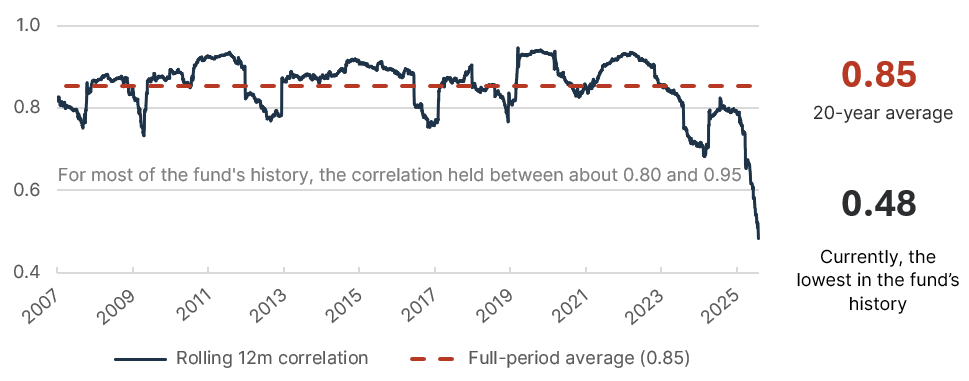
This difference is visible in the fund’s recent behaviour. Seilern World Growth’s rolling 12-month correlation with the MSCI World has fallen to 0.48, the lowest in the 20-year series. This shows that the fund currently offers a meaningfully different equity exposure, whose diversification value becomes more important when index returns are driven by a narrow set of growth drivers.
Figure 2: Rolling 12-month correlation of daily returns, Seilern World Growth versus MSCI World
What discipline requires
We have been investing in Quality Growth companies since 1996, through very different market environments. The philosophy has not rewarded clients in every one of them, nor should anyone expect it to. Its purpose has never been to predict the next turn in the market. It is to own businesses that can compound their earnings through different conditions, so that returns do not depend on calling those turns correctly.
The past three years have led some quality managers to reconsider their approach. Some have become more willing to own businesses tied to the AI capital-expenditure cycle, including companies that are more cyclical or capital-intensive than they would previously have considered. Others have decided to give greater weight to share-price momentum. We understand why these changes have been made, but we do not share this conclusion. Our philosophy is built on the belief that long-term returns come from owning businesses with predictable earnings and Quality Growth characteristics for long enough to benefit from their compounding. Clients can only know what they own, and judge whether we are doing what we said we would, if our standards do not move with the market. We will continue to reflect changes in company fundamentals in each portfolio, stock by stock, as the evidence changes. What we will not do is change the philosophy in response to market pressure.
1 Source: Factset, Seilern Investment Management. EPS in local currency, excluding cash.
2 41.3 per cent of the S&P 500 as of the 31 July. Source: Bloomberg.
This is a marketing communication / financial promotion that is intended for information purposes only. Any forecasts, opinions, goals, strategies, outlooks and or estimates and expectations or other non-historical commentary contained herein or expressed in this document are based on current forecasts, opinions and or estimates and expectations only, and are considered “forward looking statements”. Forward-looking statements are subject to risks and uncertainties that may cause actual future results to be different from expectations.
Nothing contained herein is a recommendation or an offer or solicitation for the purchase or sale of any financial instrument. The material is not intended to provide, and should not be relied on for, accounting, legal or tax advice, or investment advice. The content and any data services and information available from public sources used in the creation of this communication are believed to be reliable but no assurances or warranties are given. No responsibility or liability shall be accepted for amending, correcting, or updating any information contained herein.
Please be aware that past performance should not be seen as an indication of future performance. The value of any investments and or financial instruments included in this website and the income derived from them may fluctuate and investors may not receive back the amount originally invested. In addition, currency movements may also cause the value of investments to rise or fall.
This content is not intended for use by U.S. Persons. It may be used by branches or agencies of banks or insurance companies organised and/or regulated under U.S. federal or state law, acting on behalf of or distributing to non-U.S. Persons. This material must not be further distributed to clients of such branches or agencies or to the general public.
Get the latest insights & events direct to your inbox
"*" indicates required fields