






On 25 May 2026, inside the visionary Vela di Calatrava, Ferrari unveiled the Luce, the first fully electric car in its seventy-nine-year history. The reception was a far cry from the one Maranello had hoped for. The styling, shaped with iPhone designer Jony Ive’s LoveFrom studio, was taken apart on social media within hours. Purists invoked the image of Enzo Ferrari turning in his grave while Luca di Montezemolo, chairman from 1991 to 2014, told Italian media that the Luce risked destroying a legend and that this was “surely a car that at least the Chinese won’t copy”. Investors were equally unimpressed and shares fell by as much as 8 per cent in the following session.
Yet two months later, the Financial Times reported that this year’s entire Luce allocation, estimated to be 500 cars at €550,000 each, had been taken up before a single car reached a customer. Ferrari publishes no model-level order figures, but at the half-year results it reported orders in line with plan, a guidance raise on stronger personalisations, and an order book covering the whole of 2027. The shares were back above their pre-reveal level within a week, and higher again on the results. The furore left no mark on any number Ferrari reports.
The episode can be thought of as a microcosm of Ferrari itself: predictability despite noise. Ordinary car manufacturers breach several of our Ten Golden Rules and electrification only lengthens the list. Ferrari is not an ordinary car manufacturer, however. It is a luxury company of exceptional quality, albeit one whose growth model differs from that of more conventional luxury peers.
No Ordinary Auto Manufacturer
Close to 93 million light vehicles were produced worldwide last year. The Toyota Group alone built 11.2 million, whilst Ferrari built a mere 13,640.
The difference between these types of businesses, however, extends far beyond volume. The characteristics of a mass-market car company read almost as the inverse of our Ten Golden Rules:
- Deeply cyclical demand, tied to consumer spending and credit conditions
- Limited scope to differentiate, and therefore limited brand and pricing power
- Heavy capital requirements, from vertical integration and successive powertrain transitions
- Heavy working capital requirements, since demand is funded through an in-house financing arm
The result is an industry whose returns on capital have not reliably covered its cost of capital,[1] and whose balance sheets carry more debt than we would accept. We therefore regard mass-market manufacturers as uninvestable.
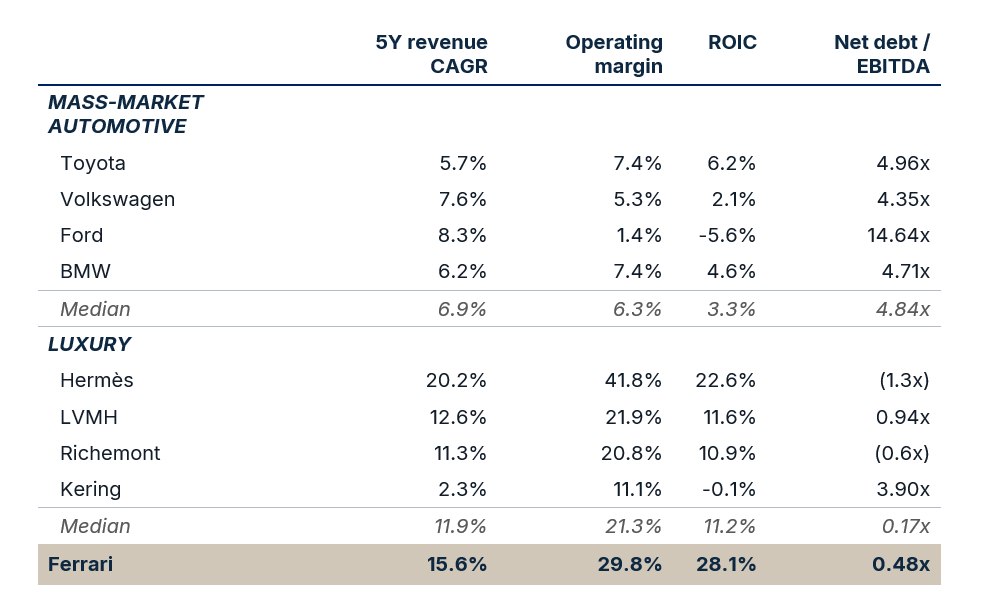
Ferrari shares none of these characteristics. Its financials are those of a luxury company and it is one of the highest quality, as measured by return on invested capital, being 28.1 per cent in 2025, ahead of the major listed luxury houses.
Figure 1: Ferrari’s financials belong to luxury, not automotive
A Luxury Company, and one of the Highest Quality
When people think of luxury, they tend to think of prestigious brands rooted in deep heritage and artisanal craftsmanship, with controlled volumes, limited editions and customers who are loyal, wealthy, and more insulated from the economic cycle. All of this holds true for Ferrari. Where the level of luxury goes further than most is on their exclusivity, and on the discipline required to protect it.
Enzo Ferrari understood early that restricting supply created mystique and formalised it as a principle: Ferrari would always deliver one car less than the market demands. On the ratio of those who know the brand to those who own it, Ferrari may be the most exclusive name in luxury. Rolex times the tennis Grand Slams and Le Mans and makes over a million watches a year. The even more exclusive Patek Philippe makes only an estimated 70,000. Ferrari, despite having raced in Formula One since the championship began and being watched by hundreds of millions every season, sells far less than both.
The same discipline governs demand and who may buy. Clients are vetted on wealth, on their existing Ferrari collection and on genuine enthusiasm for the marque; ostentatious influencers are a no-go. The best are ranked on a life-cycle value indicator and invited to buy limited editions before they know what the car looks like, against a substantial deposit. Dealers are judged on the durability of their order bank rather than purely on sales. Every limited edition launched since the 2015 listing has sold out before its public reveal, and more often than not appreciates the moment it leaves the forecourt. The geographic mix of sales is controlled just as tightly. Shipments to Greater China have been capped at under ten per cent of volumes, even as other luxury houses grew dependent on the region. China has offered faster growth than Western markets, but it carries more risk: government policy can change quickly, and its consumers are newer to luxury and quicker to move on.
What Ferrari’s discipline buys is a quality of demand visible in the numbers. The order book extends to the end of 2027 and 84 per cent of new cars went to clients who already owned a Ferrari, and 56 per cent to clients who owned more than one. It is also why Ferrari’s guidance looks unlike that of other listed luxury peers. LVMH and Richemont publish no financial targets at all, and Hermès only an unquantified ambition for revenue growth. Ferrari is unique in committing to a full set of targets for every plan period, five years at a time, alongside annual guidance, its 2030 plan specifying revenue of around €9 billion and an EBITDA margin above 40 per cent. No other luxury house provides such extensive guidance. Ferrari can because its revenue is effectively a decision rather than a forecast. On the tests we apply; pricing power, client loyalty, resilience through a downturn, returns earned without leverage, Ferrari belongs in the same small group of businesses as Hermès, and on visibility it is ahead.
Where the Comparison Falters
The flip side of that control is that Ferrari has fewer ways to grow. Hermès rations Birkin and Kelly bags like Ferrari rations its cars, but it does not depend entirely on them to grow. Those bags are part of a leather goods division worth a little over 40 per cent of sales, and the rest of the house; silk, fragrance, watches and ready-to-wear, sell at prices and in quantities that are accessible to an aspiring client. Ferrari has no such tier. Some 85 per cent of sales come from cars and spare parts, and the entry point is a vetted purchase of the Amalfi at €240,000. Apparel, collectibles and licensing build the brand but contribute little to revenue. Ferrari cannot monetise its 400 million motorsport followers the way Hermès monetises an aspiring client through a scarf. What it can do is sell each car for more, and personalisation has risen from 15 per cent of car revenues at the time of listing to 20 per cent today. But there is a ceiling to that too.
Personal luxury also carries minimal technology risk. Hermès does not have to reinvent leather; Ferrari does have to continuously reinvent its powertrain technology. Emissions regulation across Europe, China and the United States has forced the entire industry to electrify, at a cost measured in tens of billions and with results that have disappointed most that have tried. Ferrari now expects a 2030 model line-up split roughly 40/40/20 between combustion, hybrid and electric, halving the electric share envisaged in 2022. Hybrids have gone well, at 42 per cent of volumes last year. Electric is less certain, because differentiation is harder in that form: aerodynamic demands have given electric cars a converged look,[2] and no electric motor can replicate the roar of a V12.
Three things temper this risk. In a world where no powertrain differentiates, the brand does, and social stratification has outlived every technology yet invented. Second, combustion is likely to remain viable even in the strictest jurisdictions.[3] Third, and further out, lie e-fuels, made from renewable sources and chemically close enough to petrol to run in existing engines.[4] None of this means Ferrari escapes the transition facing the whole industry. But it meets that transition from a position no other manufacturer occupies, and we therefore regard the risk as manageable, while recognising it is the one we watch most closely.
A Happy Trade-Off
Ferrari’s resilience and its constraints are two sides of the same coin. Volumes are deliberately limited, clients are selected, prices rise with each new model, and an order book stretching years ahead means much of its future production is already spoken for. This discipline caps growth but also makes that growth unusually predictable. In the stock market today, growth is not scarce, but much of it is concentrated in a narrow group of businesses whose long-term durability remains uncertain. The predictability Ferrari offers is much rarer. We aim to own businesses for decades. Knowing roughly what a company will sell several years out is more valuable than a faster rate of growth on which we cannot rely. It is this combination of quality, resilience and visibility that has earned Ferrari its place in the Seilern universe.
[1] Aswath Damodaran, Professor at NYU Stern has found that the normalised ROIC for the US Auto & Truck sector over the last 10 years was 5.5 per cent, versus an average industry cost of capital over the same time period of 7.3 per cent, implying that the sector as a whole has been value destructive over the last decade.
[2] Electric cars converge on a common design form for two reasons. A battery laid flat beneath the floor raises the floor, seats and roofline, producing a tall, slab-sided body. And because aerodynamic drag consumes range, designers minimise it with rounded noses, flush surfaces and closed grilles.
[3] In the EU, Ferrari holds a small-volume derogation giving it considerable leeway on its CO2 target, which runs to 2035
[4] The EU has undertaken to accommodate e-fuels without yet legislating. Supplying them is tractable at Ferrari’s scale: it registers fewer than 3,600 cars a year in the EU, and a client paying €240,000 or more for a car will not baulk at the fuel.
This is a marketing communication / financial promotion that is intended for information purposes only. Any forecasts, opinions, goals, strategies, outlooks and or estimates and expectations or other non-historical commentary contained herein or expressed in this document are based on current forecasts, opinions and or estimates and expectations only, and are considered “forward looking statements”. Forward-looking statements are subject to risks and uncertainties that may cause actual future results to be different from expectations.
Nothing contained herein is a recommendation or an offer or solicitation for the purchase or sale of any financial instrument. The material is not intended to provide, and should not be relied on for, accounting, legal or tax advice, or investment advice. The content and any data services and information available from public sources used in the creation of this communication are believed to be reliable but no assurances or warranties are given. No responsibility or liability shall be accepted for amending, correcting, or updating any information contained herein.
Please be aware that past performance should not be seen as an indication of future performance. The value of any investments and or financial instruments included in this website and the income derived from them may fluctuate and investors may not receive back the amount originally invested. In addition, currency movements may also cause the value of investments to rise or fall.
This content is not intended for use by U.S. Persons. It may be used by branches or agencies of banks or insurance companies organised and/or regulated under U.S. federal or state law, acting on behalf of or distributing to non-U.S. Persons. This material must not be further distributed to clients of such branches or agencies or to the general public.
Get the latest insights & events direct to your inbox
"*" indicates required fields